Geothermal power and lithium plant at the Salton Sea, CA
For two decades, oil and gas on federal land have had a faster permitting track than geothermal. A new Senate bill includes provisions that would close most of that gap.
Senators Shelley Moore Capito (R-WV), Mike Lee (R-UT), Sheldon Whitehouse (D-RI), and Martin Heinrich (D-NM) introduced the Bipartisan American Affordability and Jobs Act (BAAJA), S. 5653, on September 30th, 2026. It has not yet been voted on in the Senate, and could be debated in the lame-duck session after the November Midterm elections.
Here’s a breakdown of how BAAJA impacts geothermal at each stage of project development:
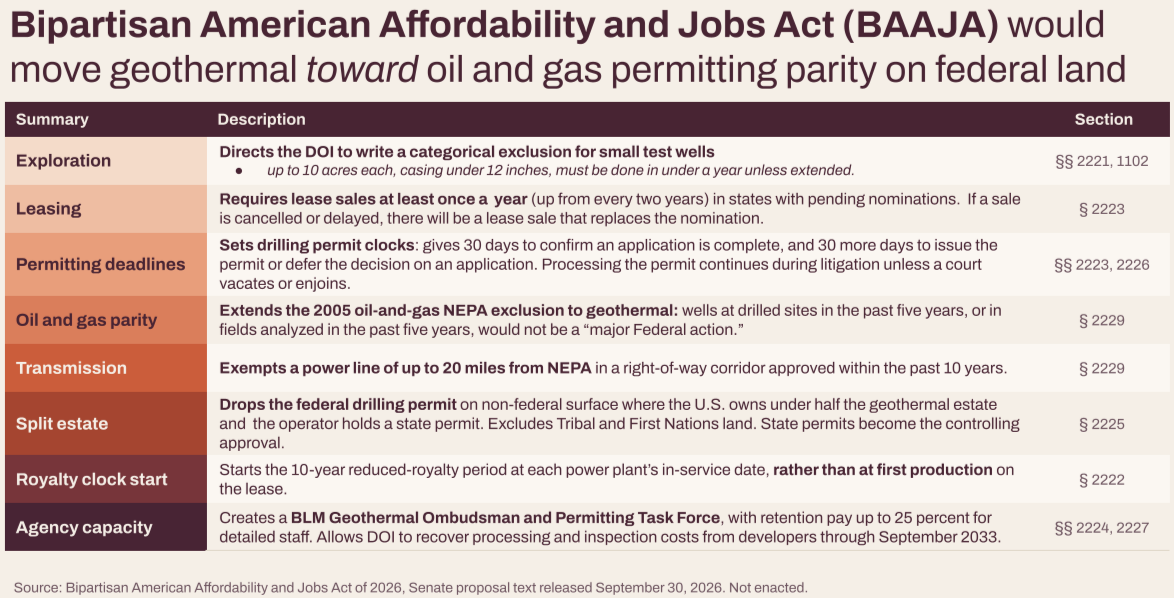
Four key provisions from BAAJA are most significant for the geothermal industry
Oil and Gas Parity
BAAJA includes a major provision the geothermal industry has been requesting for years: Section 2229 gives geothermal the same regulatory treatment that oil and gas operators have enjoyed since 2005. A new well on land drilled or studied within the past five years would not require a new NEPA review. Neither would a transmission line of up to 20 miles in a recently approved corridor. This means that, for the first time, geothermal projects could expect to be permitted on similar timelines as oil and gas (a few months vs. several years)–essential to both geothermal’s bankability and efforts to serve nearby large electricity loads coming online in a short period of time.
NEPA Categorical Exclusion
Most accessible hot rock exists under federal land, and the National Environmental Policy Act (NEPA) requires federal agencies to study a project’s effects before permitting it. Our white paper released in March this year, The Firm Frontier, found that one geothermal project can go through that study up to six times across the development process.
If BAAJA passes, the bill would create more drilling certainty for geothermal projects, further improving bankability for developers as projects have a higher likelihood of reaching completion. Section 2221 directs the Department of the Interior (DOI) to write a Categorical Exclusion (CE) for geothermal developers to do small drill tests in search of hot rock, whereas projects are currently subject to a broader environmental review.
Here’s a short breakdown of the NEPA review timelines:
Under NEPA, a federal agency has three levels of determination on how the environment is impacted. An Environmental Impact Statement (EIS) is a full study for actions on federal land with significant environmental effects. An Environmental Assessment (EA) is a shorter study that decides whether an EIS is needed. A Categorical Exclusion (CE) is a category of actions that an agency has determined, in its own NEPA procedures, normally does not have a significant effect on the human environment.
Once a category is on an agency’s list, a project that fits the parameters of the exclusion from environmental review would skip an EA and/or an EIS altogether. The agency will continue to screen and assess each project for extraordinary circumstances, including but not limited to threatened or endangered species or historic property. If the review uncovers significant impacts, the agency must pivot to prepare an Environmental Assessment (EA). Section 2221 of BAAJA directs the Interior Department to draft a Categorical Exclusion (CE) specifically for geothermal test wells, applying this exact screening process to the projects.
For geothermal deployment in particular, saving time on permitting could encourage acceleration. Federal law currently aims for EAs to take one year and EISs to take two. Before those statutory targets existed, an average EIS timeline was four years. As noted in our white paper, we found that BLM’s existing exploration CEs process takes roughly two months. Plus, putting a CE directly into statute makes it much less likely to roll back later compared to a rule an agency adopts on its own.
For developers to use the exclusion, a single test project is capped at no more than 10 acres of disturbed land, while a developer’s combined test projects on a given lease cannot exceed 100 acres. Exceeding those limits would kick a project back to the standard environmental review process. This narrowed scope is exactly why it’s called a Categorical Exclusion—the footprint is small enough that the agency can say in advance a project is unlikely to significantly impact or harm the environment.
Drilling Permit Clock
Section 2223 effectively puts drilling permits on a clock. DOI would get 30 days to inform an applicant whether their submission is complete and if not, what pieces are missing. Once deemed complete, Interior has an additional 30 days to issue the permit, assuming NEPA and other reviews are finalized. If reviews are still pending, the agency must defer in writing, itemizing the remaining steps for both the agency and the applicant, and set strict deadlines that comply with NEPA’s statutory limits. Once those final steps are completed, the permit is due within 10 days. While this doesn’t automatically issue a CE or shrink the NEPA timeline itself, the bill eliminates the open-ended, often years-long wait developers and investors face after submitting a complete application.
Standardizing BLM administrative procedures
Geothermal also makes gains in standardizing administrative procedures across the Bureau of Land Management, a crucial step in coordinating projects for offtake and deployment onto the grid. A geothermal ombudsman at the Bureau of Land Management (BLM) would resolve disputes between field offices and applicants. An updated BLM handbook, called the “Gold Book,” would give every field office the same standards and practicum to abide by.
Faster permits are not necessarily equivalent to faster access to energy. The Firm Frontier shows geothermal project development can currently happen within three to six years, and names the grid connection as the largest source of uncertainty. The bill’s transmission title would begin to rework that process. Read more on the transmission provisions of BAAJA from the Center for Public Enterprise here.
This post describes the BAAJA bill as introduced on September 30, 2026. It is an analysis, not an endorsement.